
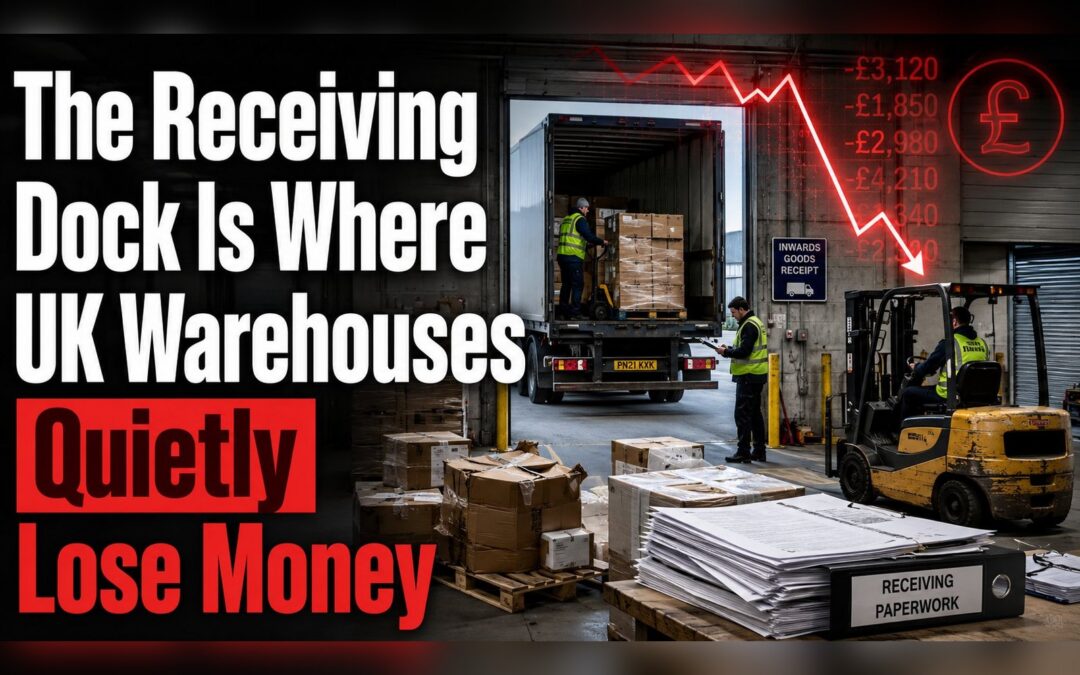
Ask a UK warehouse manager where they spend the most attention and they’ll almost always say outbound. Pick rates. Despatch SLAs. The 24-hour next-day promise. Cubic metres out the door per shift.
Now ask them how long it takes a pallet to go from arriving at the gate to being marked available-to-sell in their system. The honest answer is usually “longer than it should be”, and that’s where the real money is hiding.
We’ve spent the back end of 2025 and the first half of 2026 watching UK distributors and 3PLs realise the same thing. Outbound has been optimised to death. Inbound is still in the slow lane, and inbound logistics software is where a lot of them are now turning their attention.
The dock door blind spot
In most UK warehouses we walk into, inbound looks the same.
A lorry pulls in. The driver hands over a paper manifest or a PDF on a phone. Someone on the team counts cartons against the purchase order, scribbles discrepancies in pen, and gets to the data entry later that day. Maybe the next day.
The stock is physically in the building. Commercially it doesn’t exist yet. Sales can’t promise it. Pickers can’t pick it. Finance can’t recognise it.
When each inbound lorry is carrying tens of thousands of pounds of stock, every hour of “in the building but invisible” is a real working-capital cost. A surprising number of UK 3PLs don’t measure it, because nobody on the management report asks for it.
Why this hits UK operations harder than people think
Three things have made the inbound side worse since 2020.
Brexit customs. Even with all the systems in place, customs paperwork attaches a layer of complexity to every European inbound shipment that wasn’t there in 2019. ASN data lines up differently. Receipt against PO requires more reconciliation, not less.
Container delay variability. Felixstowe, Southampton, London Gateway: clearance times have been less predictable since 2022. Crew planning that worked off a fixed inbound schedule doesn’t work any more. If your WMS can’t show you “this container is two days out”, you’re staffing blind.
Retail compliance. Big UK retail customers (Tesco, Sainsbury’s, Asda, John Lewis) increasingly require their suppliers’ inbound and outbound to reconcile cleanly. Discrepancy charges have crept up.
Outbound speed is necessary. It isn’t sufficient any more.
What dock-to-stock actually looks like with a modern WMS
The short version: by the time the lorry pulls onto the apron, your WMS already knows what’s on it.
In TBO4 that comes from two things working together: container tracking on the way in, and ASN (Advanced Shipping Notice) receiving on the dock.
Container tracking gives you the window. You know when a container clears port, you know when it’s en route, you know roughly when it’ll arrive. That’s enough to plan staff, clear staging, and prep racks. Not enough warehouses do this. Most still find out the lorry’s late from the lorry being late.
ASN receiving handles what happens after that. When a pallet comes off the truck, the team scans the licence plate or the goods. The WMS reconciles instantly against the ASN. If the count matches, the pallet is available-to-promise the moment it’s scanned. If it doesn’t (short carton, damaged unit, wrong SKU), it flags then, not three days later when finance is trying to close.
End result: stock that used to sit invisible for 24 to 48 hours is sellable within minutes of arriving.
What it’s worth in pounds
We don’t have one number that fits every warehouse; too much depends on the value of the stock and the speed of the sales side. The levers are consistent, though:
- Working capital released. Stock that becomes available-to-sell hours sooner instead of days sooner reduces the average stock-on-hand needed to hit the same sales SLA.
- Labour aligned to actual arrival. The team that used to stand around waiting for a delayed container, or sprint to handle three at once, gets steadier throughput instead.
- Disputes resolved at the dock, not at month-end. Every short or damaged item flagged at scan time is a credit-note request you don’t have to chase later.
For a busy UK operation taking dozens of inbound lorries a week, the wins tend to show up in three places: working capital freed up as stock becomes sellable sooner, less overtime on the receiving team because labour is matched to actual arrivals, and fewer supplier discrepancy disputes dragging into month-end. We’d rather size those against your real numbers than quote a headline percentage. Every warehouse is different.
Where to start
You don’t need to rip out the inbound process to get most of the gain. The order of operations we’d suggest:
First, get ASN data flowing from your suppliers. Not all of them will give it to you, but enough will to make a difference. The ones that won’t are a separate conversation.
Second, get container tracking into your operational view. Even without changing the WMS, knowing arrival windows changes how the day is planned.
Third, get receiving onto handhelds at the dock. Paper manifests are the single biggest source of delay we see in UK warehouses, and they’re still everywhere.
If you’re using a modern WMS like TBO4, all three are part of the platform. If you’re not, the same logic still applies: start where the time leaks, not with the technology.
Related reading
- TBO4 + Your ERP: One Source of Truth for UK Warehouses
- Why UK Warehouses Are Asking About RFID-Ready WMS
If the inbound side feels slower than it should, give us a call: 01202 374121, or email s.duff@smarterwarehouse.co.uk.
Sara Duff is Commercial Director at Smarter Warehouse, the UK distributor for TBO4 WMS and TMS. Based in Bournemouth, working with UK warehouses, 3PLs and distributors. Connect with Sara on LinkedIn.