
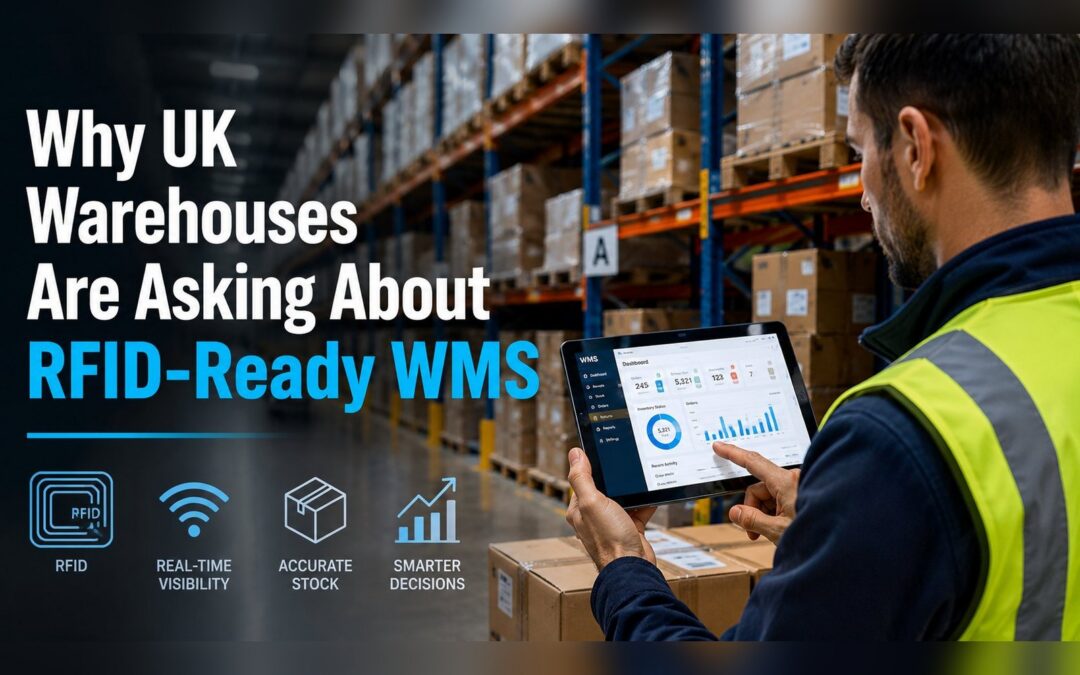
RFID is doing what barcodes did in the 1990s, going from a “nice to have” to something major UK retailers are quietly adding to supplier contracts. If your WMS can’t handle it natively, you’re a few years away from a problem.
We’ve been getting more questions about this from UK clients in the last six months than in the previous three years combined. Mostly from companies supplying high-street retailers, or running ambient and chilled distribution where pallet-level traceability is becoming non-negotiable.
So this is really a piece about RFID warehouse management: why “RFID-ready” matters more in 2026 than it did two years ago, what “ready” actually means once you get down to the WMS level, and the questions worth asking before you sign for a new system.
RFID isn’t a faster barcode
The most common mistake we hear is “RFID is basically a barcode that doesn’t need a line of sight.” That’s true on the tag side. It isn’t true on the WMS side.
A barcode scan is one event. An RFID gate read can register 40 tags in three seconds. That’s not the same shape of data at all. A WMS that was built to digest one scan at a time will hang, queue, or simply lose reads when an RFID portal floods it with bulk events.
What “RFID-ready” actually means in practice:
- The WMS handles bulk reads natively, not via a third-party middleware layer
- Reads are reconciled against expected counts in real time, so a half-empty pallet flags before the truck leaves
- Pallet, carton, and item-level tags can live in the same record
- The integration with the reader hardware (Zebra, Impinj, Honeywell) is part of the platform, not a separate project
TBO4 was built with this in mind. RFID isn’t bolted on; it’s part of the core data model.
Where UK retail is heading
Marks & Spencer has been one of the louder voices in UK retail RFID for years, and they’re not the only major retailer heading that way. We’re hearing about it more and more from suppliers to the big grocers and department stores, and the expectation is slowly working its way down the supply chain.
For UK distributors, that means two things.
First, if you supply any of those retailers, or you’re a 3PL holding stock on behalf of one of their suppliers, you’ll likely be expected to read, write and pass on RFID data sooner than most operations plan for. A WMS that can’t handle RFID becomes a commercial risk, not just a technical one.
Second, the cost of RFID tags has been falling for over a decade and is now a few pence per tag. The historical reason to delay, “we’ll wait until the tags get cheap enough”, has expired.
The middleware trap
Plenty of older WMS platforms claim RFID support. Look closely and it’s middleware: a third-party piece of software that sits between the RFID reader and the WMS, translating reads into barcode-shaped events the WMS already understood.
That works on a demo. It struggles at volume. Every read passes through an extra system. Latency adds up. The “single source of truth” everyone wants becomes two sources arguing with each other.
If you’re evaluating a WMS, the right question isn’t “does it support RFID?”. It’s “does the platform read directly from the reader, or do you put middleware between them?” The answer tells you whether you’re buying a finished product or a project.
What to ask a WMS vendor
A short checklist we give UK prospects:
- Native or middleware? If middleware, ask who supports it and what happens when it breaks at 2am.
- Pallet, carton, item: does the data model handle all three? Some platforms treat tags as a flat list. That doesn’t survive a complex 3PL operation.
- Inwards gate vs outwards gate vs handheld read: are all three supported? A demo on a handheld doesn’t tell you what happens at a dock door.
- Which readers are supported? “All readers” usually means “we wrote a generic driver and haven’t tested half of them.” Ask for the specific list.
- What’s the exception flow? When a pallet reads short by one carton, what does the floor see and who’s notified?
What RFID warehouse management means for UK warehouses now
You don’t have to deploy RFID this year. But the WMS you buy this year will probably still be running in five. Picking one that can’t handle RFID natively, knowing that UK retailers are clearly heading that way, is the kind of decision people look back on and wince at.
The honest middle path: stay on barcode for now if your operation doesn’t need RFID, but make sure the platform you choose can switch on RFID without a rip-and-replace when the time comes.
That’s what we mean by RFID-ready. Not “we’ve got it deployed already”, but “when the retailer calls and asks us to support it from quarter four, we can say yes without a six-figure project.”
Related reading
- TBO4 + Your ERP: One Source of Truth for UK Warehouses
- The Receiving Dock Is Where UK Warehouses Quietly Lose Money
If you’re being asked about RFID by a customer or by your own ops team, we’re happy to walk through what it actually looks like in TBO4. Call 01202 374121 or email s.duff@smarterwarehouse.co.uk.
Sara Duff is Commercial Director at Smarter Warehouse, the UK distributor for TBO4 WMS and TMS. Based in Bournemouth, working with UK warehouses, 3PLs and distributors. Connect with Sara on LinkedIn.