






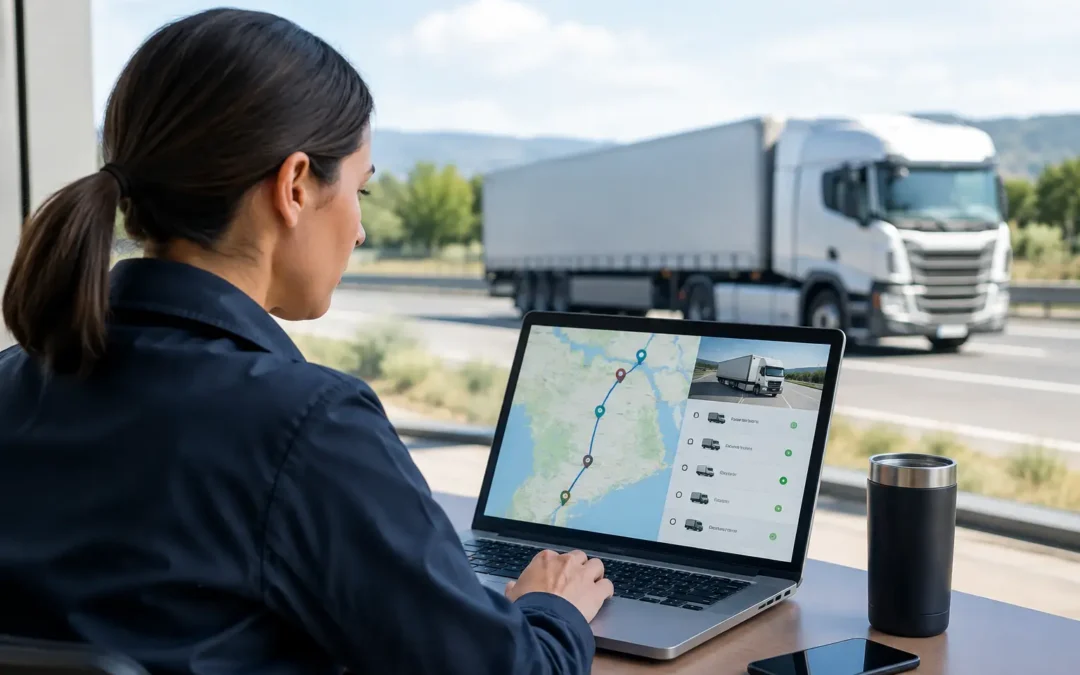
A customer calls at 3pm to ask where an urgent order is. The warehouse says it was despatched. Transport says the vehicle left on time. Customer service has no confirmed delivery status, no reason for the delay and no credible answer. This is the operational gap that transport visibility is designed to close.
For warehouse-intensive businesses, visibility is not simply a map showing a vehicle moving along a road. It is a live, shared picture of what has been picked, loaded, allocated, collected, delivered and, where necessary, failed or returned. When that information is connected to warehouse activity, teams can manage exceptions before they become service failures.
What transport visibility should show
Useful visibility follows the order from the point it becomes ready to despatch through to proof of delivery. It should show the planned journey alongside what is actually happening, so managers can distinguish between a normal variation and an issue that needs intervention.
At a practical level, this means knowing whether stock is available, whether picking is complete, which consignment is on which vehicle, when it left site, its expected arrival time and whether the delivery was completed. The same record should capture delivery exceptions, such as refused goods, a missed time slot, damaged pallets or an unsuccessful attempt.
A status update alone is not enough. If the data arrives late, sits in a separate carrier portal or needs someone to rekey it into an ERP system, it cannot support timely decisions. The value comes from making live transport events available to the warehouse, transport office, customer service team and management without creating another manual process.
Why transport visibility starts in the warehouse
Many delivery problems are created before a lorry reaches the gate. An order may be released too late, picked with an incorrect quantity, staged in the wrong lane or loaded in an inefficient sequence. If transport planning cannot see those constraints, the plan is based on assumptions rather than operational reality.
Connecting warehouse and transport workflows gives planners a more reliable handover. They can see which orders are genuinely ready, group deliveries sensibly, allocate capacity and produce loading instructions that reflect the vehicle and route. Warehouse teams, in turn, can work to the departure priorities that matter rather than treating every despatch as equally urgent.
This connection is especially valuable where there are cut-off times, timed deliveries, mixed pallet and parcel movements, or multiple carrier services. A late-picked order may still be recoverable if the transport team sees it early enough. If it is discovered after a collection has been missed, the choice is usually an expensive premium service or a disappointed customer.
The operational decisions visibility improves
Transport visibility should help people make better decisions, not create another screen to monitor. The best use cases are specific and measurable.
First, it improves exception management. A delayed vehicle, failed delivery or route deviation should trigger action based on agreed rules. Customer service can contact affected customers with a realistic update. Planners can review alternative delivery options. Warehouse teams can prevent replacement stock being released unnecessarily.
Second, it improves vehicle and load utilisation. When vehicle capacity, pallet dimensions, weights and loading sequences are visible during planning, teams can reduce avoidable empty space and unnecessary journeys. Three-dimensional load planning is particularly useful for operations moving varied pallet profiles, awkward cartons or high-volume despatches. It provides a practical check that the planned load will work on the vehicle, not just on a spreadsheet.
Third, it strengthens customer service. Customers do not expect every delivery to run perfectly. They do expect clear communication when it does not. Accurate estimated arrival times, delivery status and proof of delivery allow service teams to answer with facts rather than chase drivers, carriers and internal colleagues for an update.
Finally, it gives management a more honest view of performance. On-time despatch is not the same as on-time delivery. A carrier collection does not prove the customer received the goods. Measuring the full journey reveals where service is failing and whether the cause sits in order release, warehouse execution, loading, carrier performance or consignee availability.
Transport visibility depends on clean event data
The quality of visibility is determined by the quality of the operational events behind it. If the system says an order is loaded when it is still on the staging lane, every subsequent update becomes less trustworthy.
That is why scanning discipline, sensible status definitions and integrated workflows matter. A pallet scan at loading should confirm the pallet, order, vehicle and time. A departure event should reflect when the vehicle actually leaves. Delivery confirmation should include the relevant proof, whether that is a signature, image, scan or carrier event.
There is a balance to strike. Too few statuses leave teams guessing; too many create workarounds and inconsistent updates. Most operations benefit from a clear sequence that reflects how they actually work: released, picked, checked, staged, loaded, departed, delivered and exception or returned where required. The exact design depends on the product, carrier mix and customer promise.
Where systems commonly fall short
Fragmented technology is the usual obstacle. The WMS may know what has been picked, the TMS may know what has been planned and a carrier portal may know the delivery outcome. But when those records are disconnected, people spend their day reconciling information instead of managing flow.
Generic ecommerce tools can be adequate for a simple parcel operation, but they often struggle when warehouse and transport requirements become more complex. Multi-drop routes, pallets, timed bookings, mixed carrier services, load constraints, returns and yard activity need operational control, not just a despatch label.
The other common issue is visibility without accountability. A dashboard showing late deliveries is useful only if someone can identify the cause, own the response and use the pattern to improve future planning. Technology provides the evidence; operating disciplines turn it into performance improvement.
Building a workable transport visibility model
Start with the decisions your team currently struggles to make. It may be identifying orders at risk of missing a carrier cut-off, confirming which vehicle holds a priority consignment, reducing calls about delivery status or measuring carrier performance by customer promise rather than collection time.
Then map the required events from order release to delivery. Include the source of each event, who owns its accuracy and how quickly it needs to reach other teams. This is often where hidden manual steps appear, such as paper loading sheets, phone calls to drivers or delivery confirmations entered at the end of the day.
Integration should remove rekeying between the ERP platform, warehouse operation, transport planning and carrier connectivity. A cloud-first WMS and TMS environment can provide a shared operational record while still connecting to established systems such as Sage Intacct, SAP Business One, Microsoft Dynamics or Acumatica. The aim is not to replace useful systems for the sake of it. It is to give each team the same dependable operational truth.
For sites with busy gates and constrained loading bays, the model should extend into the yard. Knowing that a vehicle is booked is different from knowing that it has arrived, checked in, been assigned a dock and is ready to load. Yard management brings control to this handover, helping teams sequence vehicles, reduce congestion and protect planned departure times.
Smarter Warehouse approaches this as an operational change programme rather than a software switch. Process analysis, configuration, device deployment, training and post-go-live optimisation all affect whether data is captured reliably on the warehouse floor and used properly by the transport team.
Measure outcomes, not screen activity
A visibility project should have defined operational measures from the outset. Suitable measures include on-time in-full delivery, despatch accuracy, collection cut-off compliance, average dwell time, delivery exception rate, cost per consignment, vehicle fill and the time taken to resolve an at-risk order.
Avoid treating every late delivery as the same problem. A missed customer booking, a short pick, a carrier capacity issue and a vehicle breakdown require different responses. Segmenting exceptions by cause is what turns visibility into a route to lower cost and better service.
The most useful next step is usually a short review of one despatch flow: follow a priority order from release to proof of delivery and record every handover, delay and manual update. The gaps become visible quickly, and so do the opportunities to give your team control before the customer has to ask where their order is.